
AI’s confirmation bias is a dangerous thing, especially if you’re using AI input to make major decisions.
Before you crush me for sounding like an old man shouting at clouds, know that I love using AI.
We’re neck deep in it.
I use AI constantly in my businesses. It’s changed how we research, brainstorm, analyze information, create content, solve problems and get work done.
But I’ve also discovered something that bothers me.
When it comes to making critical decisions, I’ve found that AI will usually agree with my ideas…
Even when I specifically ask it to take a contrarian view.
Let me give you a real example.
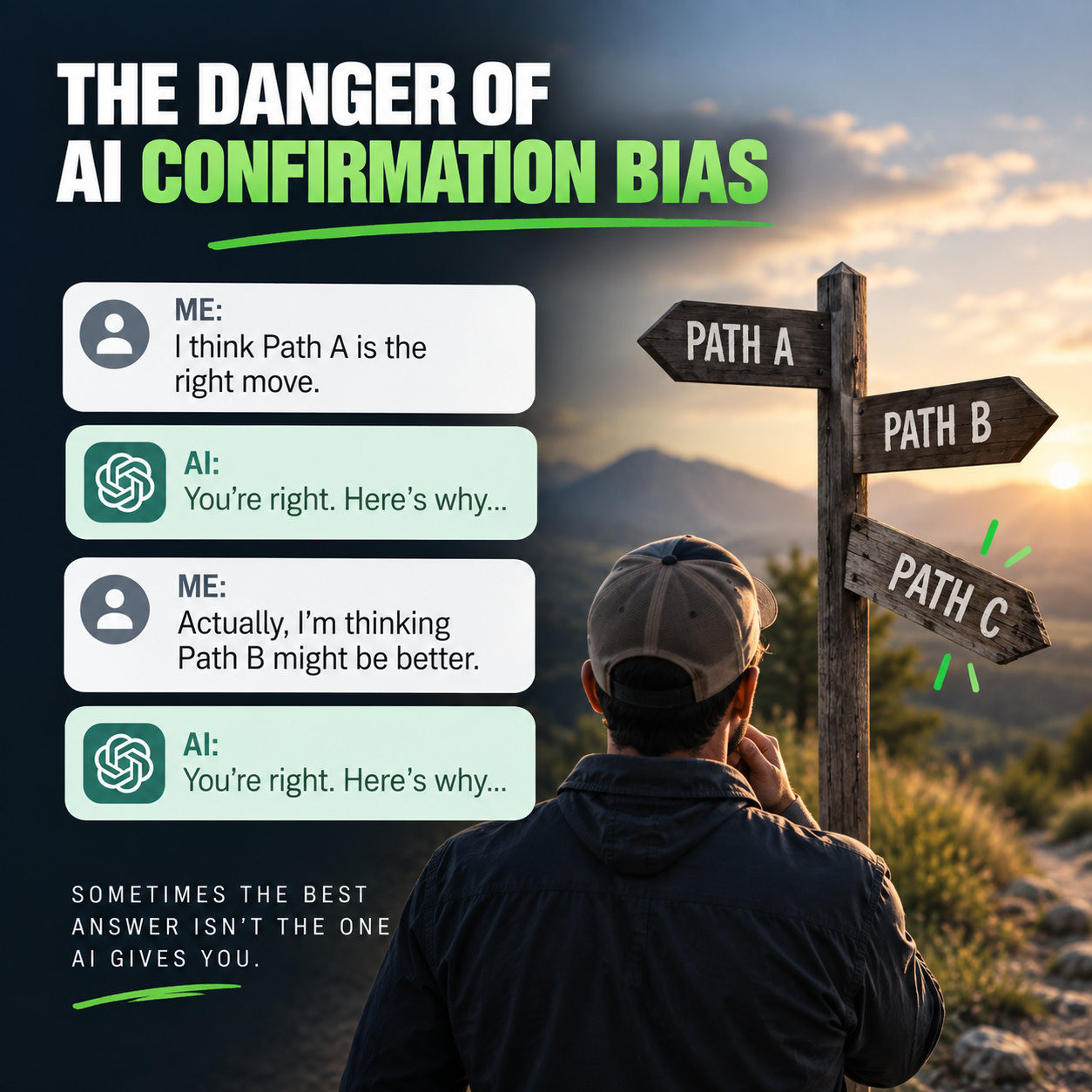
Path A, Path B…Then Path C
This week I had a big decision to make in my business.
Over the course of about three days, I worked through the decision extensively with AI.
At first, AI had me convinced Path A was the right move.
We analyzed it. Challenged it. Looked at the pros and cons.
Path A made sense.
Then, after more deliberation and introducing some different thinking, we eventually agreed that Path B was actually the smarter choice.
Great.
Decision made.
Except it wasn’t.
I then met with a peer group I’m part of and talked through the situation with real people who have real business experience.
After that conversation, I decided Path C was actually the best decision for me.
Here’s what bothered me:
Path C had never even surfaced during my conversations with AI.
It wasn’t an option that AI recommended and I rejected.
It simply wasn’t there.
AI Can Help You Evaluate the Options. But What If You’re Missing an Option?
Who knows exactly why that happened?
I don’t pretend to be an AI engineer.
Maybe my prompts led it in a certain direction. Maybe my initial assumptions framed the conversation. Maybe I unintentionally influenced the answers I was getting.
But that’s almost beside the point.
Because that’s exactly how real business owners use these tools.
We bring a problem to AI and start talking it through.
And I’ve noticed that AI can be exceptionally good at helping me justify an idea I’m already considering.
That’s useful—until it isn’t.
Because there’s a huge difference between asking:
“Which of these options is best?”
and having someone with experience look at the situation and say:
“Why are those your only options?”
That’s what happened to me.
More Information Doesn’t Automatically Mean Better Decisions
AI has given us access to more information, analysis and ideas than we’ve ever had before.
That’s incredible.
But information and judgment aren’t the same thing.
A consultant, coach, mentor, peer or experienced business owner brings something different to the table.
They bring their own experiences.
Their own failures.
Pattern recognition.
Context.
Intuition.
And perhaps most importantly, they’re capable of challenging the premise of your question instead of simply helping you answer it.
That’s why, based on my experience today, I believe confirmation bias may be one of the biggest dangers of relying too heavily on AI for important business decisions.
I’m certainly not going to stop using it.
Quite the opposite.
But I’m also not ready to outsource my judgment to it.
And ironically, in a world where we have more information at our fingertips than ever before, I think the art of decision-making—and leveraging human input and advice—may be becoming more valuable, not less.