

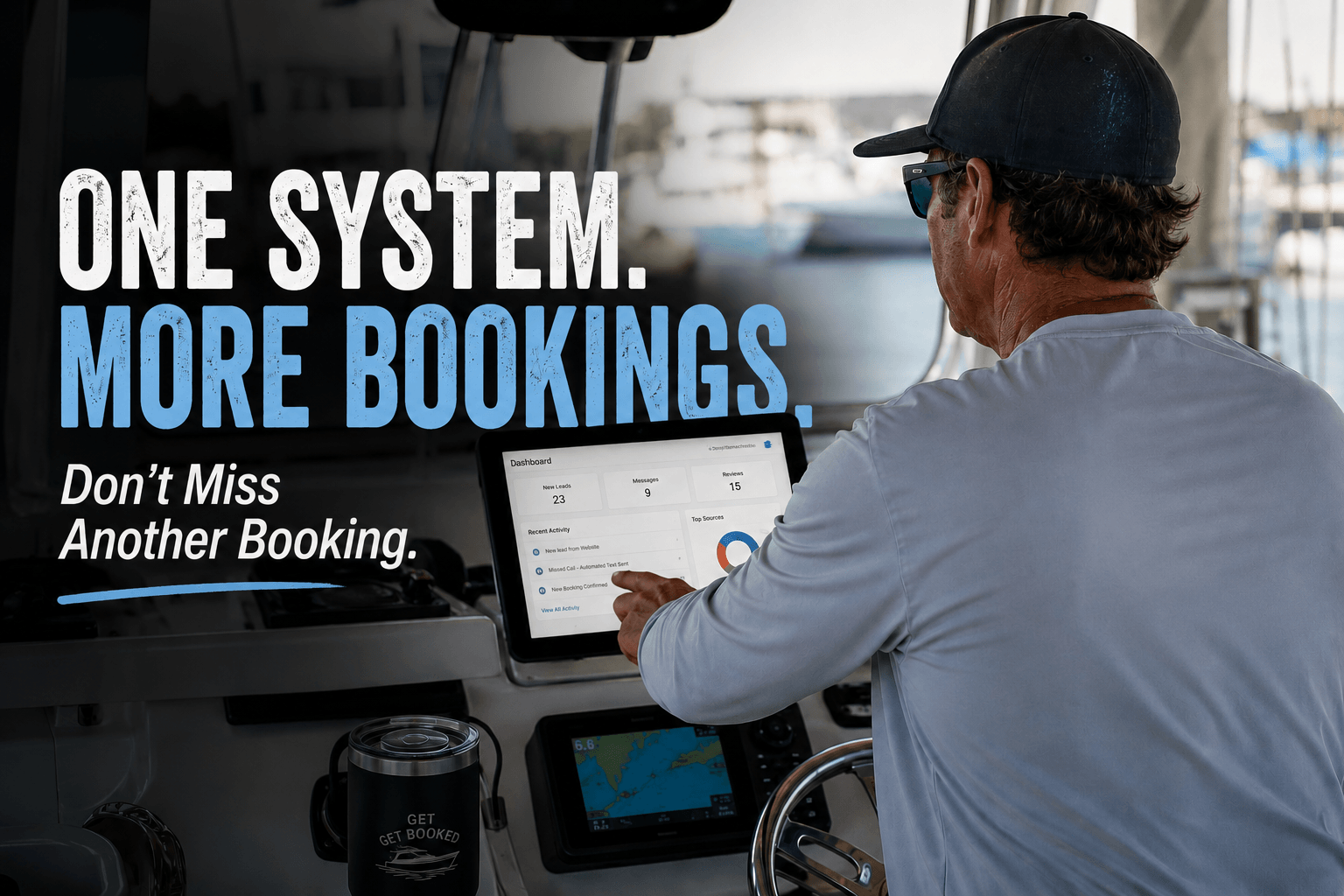
Quick Answer: Most charter captains who are actually growing don’t run five disconnected apps — they run one system that handles marketing, lead capture, review generation, lead nurture, customer CRM, email, and text messaging together.
The Problem With Running Five Different Tools
Most captains don’t start out with one system. They start with a website someone built them years ago, a Facebook page, maybe a booking tool, and a phone that rings while they’re out on the water.
Each of those tools does its own job in its own corner. The website doesn’t know a lead just texted. The booking software doesn’t know that lead never got followed up on. Nothing talks to anything else.
That’s not a technology problem so much as a time problem. Every gap between tools is a place a lead falls through, usually while the captain is busy actually running the business.
What “The System” Actually Covers
A real system covers seven things working together: marketing, lead capture, review generation, lead nurture, customer CRM, email marketing, and text message marketing.
Marketing is what gets someone to your site or your Google Business Profile in the first place. Lead capture is what happens the moment they call, text, or fill out a form — including the ones that come in while you’re on the water and can’t pick up.
Review generation and lead nurture are what happen after the trip. A CRM keeps track of who’s booked before, what they booked, and when they might be ready to book again. Email and SMS are how you reach them when that moment comes.
None of these pieces does much on its own. Together, they’re the difference between a business that has to keep finding new customers and one that keeps the ones it already has.
Why Booking Software Alone Isn’t Enough
Booking platforms like Peek and FareHarbor do one job well: they take a reservation once someone has already decided to book.
That’s a real and necessary job. It’s just not the same job as getting someone to decide in the first place, catching them if they call and nobody answers, or reminding them next season that it’s time to book again.
A lot of captains assume their booking software is their marketing. It isn’t. It’s the last step in a process that has to happen before it.
What This Looks Like Day to Day
A potential customer calls while you’re forty minutes offshore. In a disconnected setup, that call goes to voicemail, and there’s a good chance they call the next captain on their list.
In a connected system, that missed call triggers an automatic text response within seconds. The lead gets captured. A follow-up sequence kicks in if they don’t respond right away.
After the trip, a review request goes out automatically, and the customer gets added to an email list for next season. None of that requires the captain to remember to do it.
Why This Compounds Over a Full Season
One missed lead doesn’t sink a season. But a system that consistently drops two or three leads a week adds up to a real number by the time the season ends — a number most captains never see, because a lost lead doesn’t show up anywhere as a loss.
A system that reliably captures, follows up, and nurtures every lead doesn’t need to beat the competition dramatically. It just needs to not lose the ones that were already yours to keep.
What to Look for Before You Commit to Anything
Not every tool that calls itself a “system” actually is one. A real test: does it handle a missed call without you touching it, or does it just log the call for you to deal with later?
Ask the same question about reviews. A system that reminds you to ask for a review isn’t the same as one that sends the request automatically the moment a trip ends, while the experience is still fresh in the customer’s mind.
And ask what happens to a lead that doesn’t book right away. A real system keeps following up on a reasonable schedule. Without that, a maybe becomes a no by default, simply because nobody circled back.
Why Captains Tend to Underestimate This
Most captains got into this business because they’re good on the water, not because they wanted to run marketing software. That’s not a knock — it’s exactly why the system needs to run itself.
The captains who eventually adopt a real system usually do it after losing a booking they can point to directly — a call they know they missed, a lead they know went cold. That’s an expensive way to learn the lesson.
The alternative is deciding upfront that marketing infrastructure matters as much as the boat itself, since neither one runs the business without the other actually working.
